GEOMETRIC SCALES
Karen Bennicke & Masamichi Yoshikawa
4 October – 24 November 2018
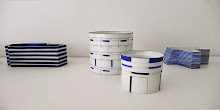
Geometric scales – a duet of architectural ceramic forms.
Geometry and experimental interests are shared by Japanese Masamichi Yoshikawa and Danish Karen Bennicke.


The exhibition sets the two world-renowned ceramic artists in a special material and form dialogue, where the exhibitors in their personal language of form reveal differences, visualize cultural references, show exciting contradictions and fine connections.

The exhibitors explore geometrical form characteristics and glaze effects, but the pieces reflect as much the philosophical, cultural and aesthetic approaches.
 Masamichi Yoshikawa insists on submersion, intimacy and reflection in his Japanese philosophical thinking.
The sculptural focal point is a symbiosis of modelled constructions in white porcelain and celadon glaze, thin and deep blue-green layers or with drip of the glaze's abundance.
The nature of the materials takes over the geometric sharp edges of the forms, associating lakes, waterfalls and raindrops in the poetic abstract landscapes of the pieces.
Karen Bennicke works in spatial vision - constructions reminiscent of architecture. Her pieces associate the functional concrete in harmonious balance with the illogical indefinable and intuitive.
All exhibition pieces by Karen Bennicke - number order as the exhibition list:


Karen Bennicke DK
 "I am fascinated by form.
Seeing it everywhere.
Playing with it,
 pinching one eye,
 and finding connections and contradictions.
In search of expression."
 "My pieces are spatial visions - architectures with memories of architecture. They establish a kind of form-carrying membrane between the interior and the exterior space.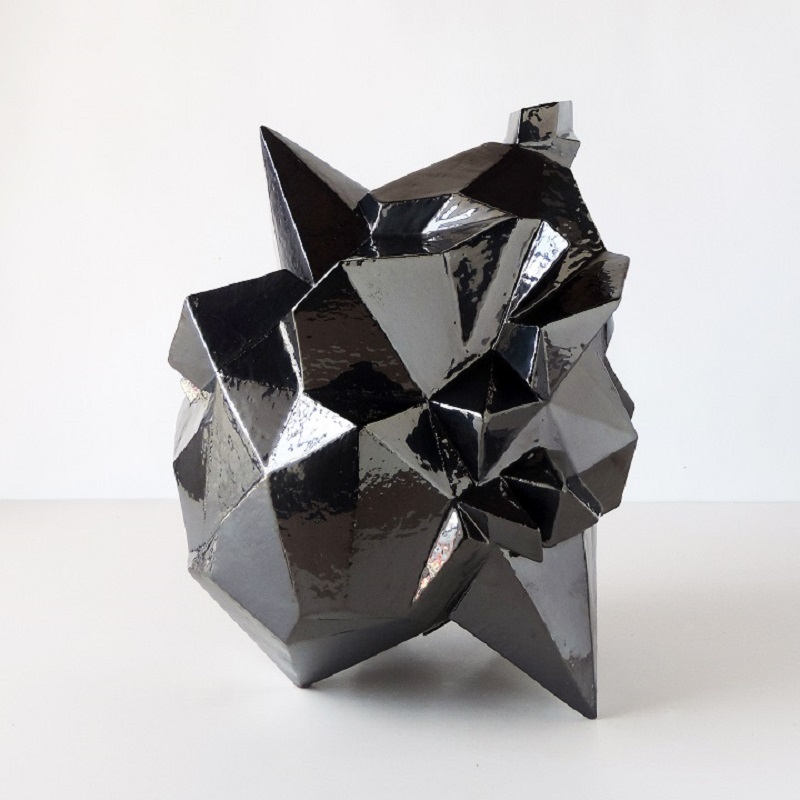
 Light, and thus of course shadow, are the most important factors in an intuitive mathematical construction of the pieces.
 They operate in an area between something recognizable, often with functional references and something indefinable that takes place between the harmonic and the almost chaotic.
 I try to eliminate the distance between the logical, concrete world of form we know from our everyday lives, and the illogical, unknown and absurd."
From the book: Karen Bennicke - Spatial destabilization.
Quote by museum director Anne-Louise Summer, Design Museum Denmark.

 "There are contradictory opposites embedded in the work by Karen Bennicke. The immediately sensual encounter the speculative constructed.
Often intuition is a starting point, but at the same time working with complex geometries - and mathematical calculations underlying the constructive form and spatial formations.
Karen Bennicke works as an engineer with the inspiration of the technical sciences, where everything from urban planning to dish antennas, satellites and space rockets are traceable into the form universe."
KAREN BENNICKE (b. 1943) was educated from potteries in the South Zealand 1958-61. Own studio since 1961. Numerous exhibitions in Denmark and abroad, represented in museums and collections in Denmark, Norway, Sweden, Germany, England, Latvia and Japan. Received grants and awards from eg Danish Arts Foundation, Danmarks NationalBank's Jubilee Foundation, Inga and Ejvind Kold Christensen Honorary Award, Annie and Otto Johs. Detlefs Ceramics Award, the National Arts Foundation Honorary Award and Bindesbøll Award. Member of the Artists' Association BKF, International Academy of Ceramics IAC. Publication: Karen Bennicke – Spatial Destabilization. www.karenbennicke.dk
Masamichi Yoshikawa - Japan
“Through my art, I strive to describe the eternal becoming of life in clear and transparent forms.
水炎(Suien) — Water flame, the appearance of water and ice.
All exhibition pieces by Masamichi Yoshikawa - number order as the exhibition list:


Yoshikawa concentrates on Seihakuji, celadon blue glazed contemporary ceramic pieces in porcelain. He lives in Tokoname, a famous traditional pottery town on a peninsula in the Aichi area, south of Tokyo.
 While celadon porcelains are traditionally celebrated for thin and sharp forms, Yoshikawa creates sculptural forms in porcelain after his own Japanese aesthetic: thick, bold, and covered with pooling and dripping Seihakuji glaze. - wikipedia.org/wiki/celadon


Yoshikawa visited Europe in the 1960s and was captivated by the medieval castle architecture. In addition to his domestic eastern influence, his works reveal this western influence. When he first visited Europe 40 years ago, he was fascinated by William Turner's paintings, as well as the castles in Europe, still considered in his architectural pieces as crenel-like ornaments.
His works consist mainly of vases/containers that he creates on the potter's wheel, or he builds them from slabs of porcelain.

His non-turned works are mostly geometric and asymmetrical.


He uses clear white 'Hakiju' Korean porcelain, often combining with 'Qingbai', transparent light blue glaze. At times, he cuts a drawing, calligraphy in the still raw clay surface, which he fills with cobalt. His unique technique and reinterpretation of the classic form has received both national and international recognition and fame.


MASAMICHI YOSHIKAWA was born in 1946 in Chigasaki, Kanagawa, Japan. He graduated in Design & Interior in Japan in 1968. From 1968-71 he worked with Junpei Sugie, Tokoname. Since 1969 he has participated in numerous exhibitions around the world (Japan, France, England, Italy, The Netherlands, Denmark) and has received several awards. The Metropolitan Museum of Modern Art in New York and museums, where he has exhibited in Europe, has acquired his works in their collections. Since 1975 he has had his own studio workshop in Tokoname.
Previous pieces:


Grateful thanks to The Danish Art Foundation for project funding in 2018.